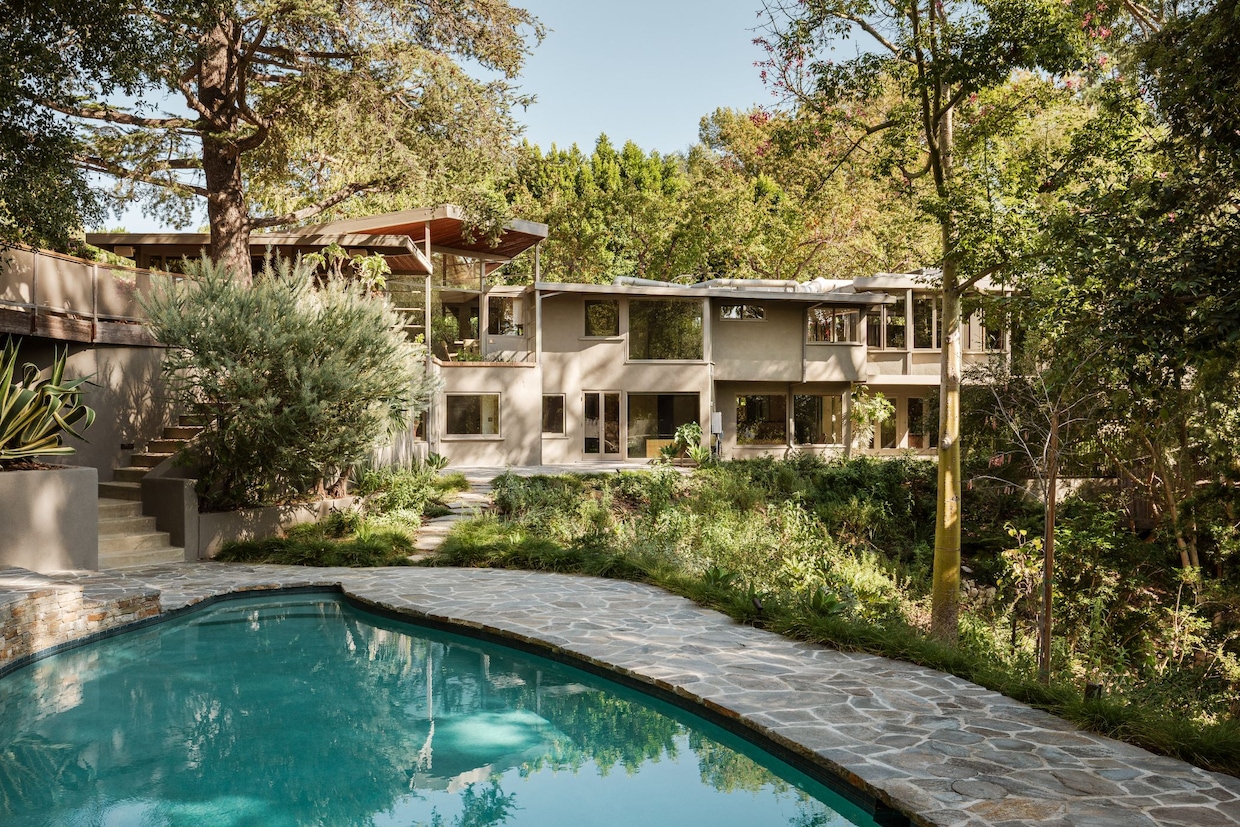
In the landscape of covetable Los Angeles architecture, a home designed by architectural heavyweight Rudolph Schindler sits high on the list.
“People really feel like this is a collectible piece of art,” said Compass broker George Penner.
The Viennese-trained architect designed roughly 100 built structures around L.A. after coming to California by way of Chicago, a hub of 20th-century modernism — a mere blip within the state’s millions of residences. They’re a rarity, the agent explained, and some of today’s surviving Schindler homes are in better shape than others.
The Lechner House, a 4,002-square-foot Schindler at 11600 Amanda Drive, falls into the former category: it’s in excellent shape thanks to an extensive restoration and continued care. Now, the home, also known as Los Angeles Historic-Cultural Monument #1024, which signifies its recognition by the city, is back on the market for $6.5 million. Penner is co-listing the property with Sotheby’s International Realty agent Stefani Stolper.
The V-shaped house is tucked into a canyon
Schindler arrived in California to run Los Angeles studio operations for Frank Lloyd Wright, helping manage the construction of Wright’s first L.A. commission, Hollyhock House, in 1920.

From there, the architect launched his own studio, honing an architectural language now deeply intertwined with Southern California modernism. Schindler completed The Lechner House in 1949, toward the end of his career — he died at age 65 in 1953 — nestling the meandering, V-shaped residence into a Studio City canyon side.
For the four-bedroom, three-and-a-half-bathroom home’s design, Schindler paired angular forms with full-length windows, Penner said, embodying his so-called space architecture approach. By juxtaposing a structured interior with its uninhibited surroundings, the project “almost has a religious experience” to offer those in the home, Penner said, a feeling reinforced by the strength of the home’s central stainless-steel fireplace, which bounces soft panels of sunlight across the room.
Around 2008, time began to weigh on the rock-bound residence, so designer Pamela Shamshiri bought the home, becoming its ninth owner and aiming “to liberate the Schindler within.”
“The state in which we found the house was, in a word, bleak, so our mission was clear: save it, restore it, and give it a new life for a new century,” stated her eponymous firm, Studio Shamshiri, on its website.
Shamshiri spent eight years freeing the home’s signature plywood detailing and angular fireplace from “incongruous” Sheetrock. She delicately modernized its systems and appliances, giving the house a new character that’s “decidedly a Schindler; it’s just not your grandmother’s Schindler,” the firm stated.
One not-your-grandmother’s-Schindler move? Leaving the oval pool unfinished so the designer’s children could spray paint the interior and use it as a mini skate park.
A throughline of creativity is driving interest in the listing
In 2019, Shamshiri sold the Schindler for $4.88 million, a touch above the $4.8 million asking price. Those buyers — today’s sellers — gave the home another patina of new character, restoring the pool and maintaining the property in a way you might expect for a neighborhood that has “a lot of star power,” Penner explained.
“You’re tucked away on this very small, little tiny road above the city,” Penner said. It’s secluded and tranquil, he noted, somewhat of a studio haven for artists. That might explain the throughline of creativity he’s noticed in interested buyers so far. “They’re directly connected to creative endeavors.”
At the same time, those very tiny canyon roads are winding, which can be a pro (an extra buffer from traffic) or a con (driving hazards) depending on how you look at it.
“However, I will say that we really haven’t had one negative comment,” Penner said. Because of “the rarity of Schindler houses in general, they almost transcend any negative value.”