It’s been over 100 years since the first Chicago bungalows were built, and the iconic Windy City architecture still makes up one-third of the housing stock.
Over the past century, Chicago bungalows have transformed from modest homes to modern residences throughout the city and adjacent suburbs. Some maintain their original character, while others have reworked floor plans and second-story additions, colloquially called “pop tops.”
These housing types have been a symbol of sorts for the city. The history of the Chicago bungalow goes back to 1910. These structures were built through the mid-1930s to accommodate nearly 1 million new residents. They were designed to be affordable and plentiful.
Developers built in large volumes to achieve economies of scale and often left the basement and half-story attic spaces unfinished to deliver a cheaper product. This gave homebuyers a way to expand their livable spaces when they had the financial means. Often, homeowners rented out their upper floors to boarders for extra income, according to Carla Bruni, preservation and resiliency specialist at the Chicago Bungalow Association.
In 2000, Chicago’s Mayor Richard M. Daley created the CBA to encourage the preservation of the Chicago bungalow while educating on its history.
A journey through the so-called Bungalow Belt neighborhoods — a term used to denote the belt-shaped arch running from the city’s southernmost tip to the north, where bungalows were built — is itself a tour of Chicago history.
These four for-sale bungalows also showcase a look at the changing needs and design aesthetics of Chicago-area residents:
2107 East Ave., Berwyn, Illinois
$569,000

This Berwyn, Illinois, bungalow shows off different design details implemented in the 1920s. There’s additional ornamentation with touches of gray brick within the red brick, and the main floor has an original stained-glass window.
Bruni previously told Homes.com that once the flashy Roaring Twenties came around, the fashionable era found its way into some of these bungalows in the form of more ornamentation.
The house also has a “jerkinhead” roof, a nod to a fashionable men's jacket worn in medieval times. It's also called a clipped gable roof. The roof looks like a traditional gable style — where two sloping sides meet at a point — but with that point being clipped. This design emerged in the 1920s, according to the CBA.
Inside, the home is reimagined with gray wall paint and white painted millwork. It was recently remodeled this year and includes a fully finished half-level at the top and full basement at the bottom. Surrounding the fireplace is traditional built-in shelving seen in many Chicago bungalows.
The kitchen has quartz countertops and custom soft-close cabinetry. The home has four bedrooms and two bathrooms across 1,415 square feet, not including the basement.
8746 S. Wood St., Chicago
$399,000
Also built in the 1920s, this Chicago bungalow located in the Chicago South Side neighborhood of Auburn Gresham shows off a polygonal bay window.
Every Chicago bungalow has a bay window, but developers changed some exterior styles to bring diversity across bungalows. Some bay windows might be flat or be set behind a porch. The polygonal bay window protrudes and has multiple sides, hence its name.
This bungalow has a dormer addition on one side of the top floor, which expands the upper level to accommodate an additional second-floor bedroom and bathroom. A remodel was completed in August, including finishing the basement, and adding new plumbing, electric, concrete, furnace, and air conditioning.
Inside, the moved staircase helped create an open floor plan between the living and dining rooms. Replacing the traditional brick fireplace is a black shiplap fireplace. The kitchen includes quartz countertops and backsplash, porcelain flooring, and stainless-steel Samsung appliances.
The finished lower level includes one bedroom with a flex room, full bathroom, and built-in beverage center. There are two bedrooms on the main level and two on the second.
5121 W. Newport Ave., Chicago
$649,000
In 2016, the CBA began a campaign against second-floor tear-off additions to bungalows. Called “pop tops,” the effort targeted developers who tore off the second floor of a bungalow and added an entirely new second floor.
The bungalow on West Newport Avenue in the Chicago neighborhood of Portage Park showcases a second-floor addition that the association regarded as respecting the original design and a solid alternative to a pop-top.
Rather than tear off the second floor and the dormer window — a classic Chicago bungalow trait — the home adds an addition behind the dormer. This addition expanded the half-story to accommodate three bedrooms, a storage room, and a bathroom.
Most Chicago bungalows had two bedrooms on the main level. This home includes one, replacing the square footage of the second with an extended open kitchen-dining room and living room.
The home has a finished basement with a built-in bar, bathroom, and storage room. It comes with a detached two-car garage and back deck.
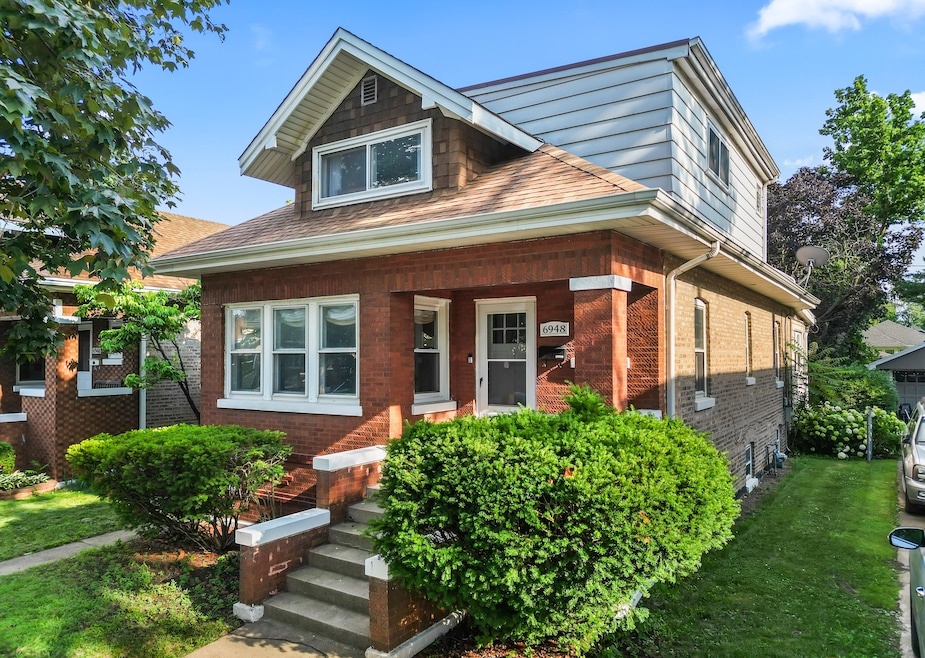
6948 30th St., Berwyn, Illinois
$410,000
This Berwyn home also has a dormer addition on one side, but on the main level, it closely resembles the original classic Chicago bungalow layout.
The front door opens to a vestibule and then the living room, which is adjacent to the dining space (modernized to an open floor plan). Historic floor plans for the Chicago bungalow often show an archway or whole wall between the two rooms, a hall that opens to a bathroom and two bedrooms, then a kitchen, and a sunroom in the back.
A large primary suite on the second expanded floor includes a full bathroom and is joined by an office nook that peers out the home’s rear-facing dormer window.
All Chicago bungalows are made of brick because it was an abundant material in the area, making it both structurally sound against the Midwest weather (winters, most notably) and more affordable. How the bricks were used vary greatly, noted the CBA. This home has waffle-textured brick. According to the association, this was done by pressing textured rollers into the wet clay.
