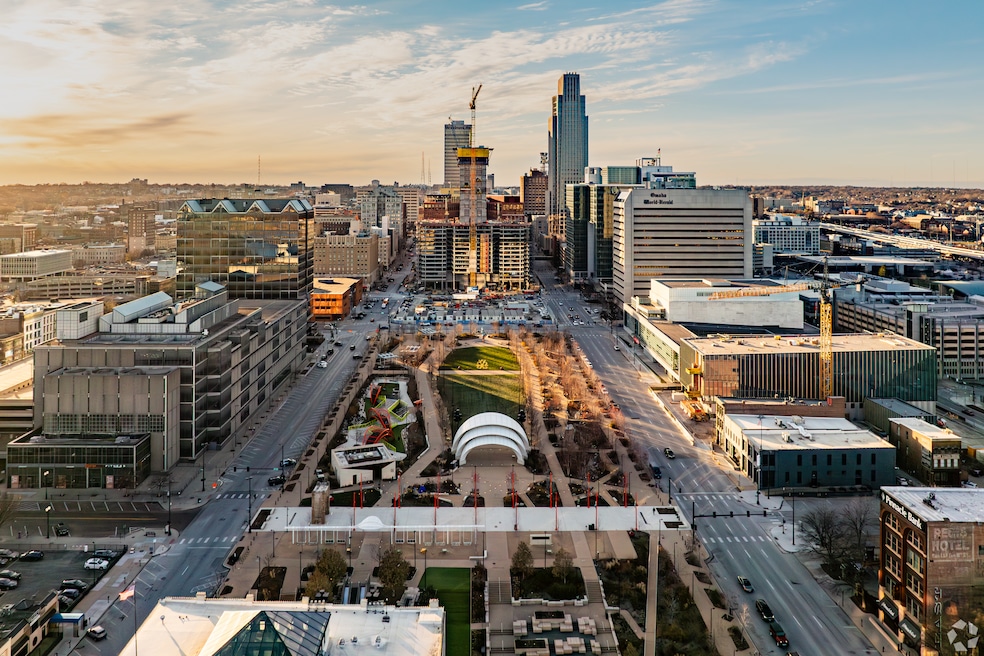
People living outside of Nebraska might know Omaha as the place where prolific Wall Street investor Warren Buffett once held court at the annual meeting for his company Berkshire Hathaway. But The Big O has more to offer anyone looking to move to the city.
There's the Lewis & Clark National Historic Trail, the Henry Doorly Zoo and the Freedom Park Navy Museum. Those attractions and the region's culture and housing opportunities may be the reason Omaha's metropolitan-area population grew past 1 million for the first time ever last year. U.S. Census Data indeed shows that thousands of more people have been moving to Nebraska's largest city in recent years.
Here's how transplants in Omaha can blend in with the locals as soon as they arrive:
1. Everything is 'Go Big Red'
Omaha is made of a collection of distinct neighborhoods with different demographics, but most everyone in the city is united under one sports phrase: "Go Big Red."

Go Big Red is the rally cry that fans of the University of Nebraska say when cheering on student athletes. Anyone moving to Omaha, or anywhere in Nebraska for that matter, should know what that means and why it's important, natives told Homes.com.
"You have to understand that we don't have a professional basketball or professional football team, so our Huskers are everything," said Omaha native Josefina Loza. "Our Huskers, regardless of if they're doing well or not, we will cheer them on through and through."
Loza, a former local journalist who now owns a public relations firm, said talking about the NU football or basketball team is the quickest way to plug into living in Omaha.
"If you're around Nebraskans and you don't know what to say and it's football season, just say, 'How 'bout them Huskers?'" she said.
2. Learn the difference between yeah, no and no, yeah
Moving to Omaha also means a newcomer must learn how to speak Midwestern, Omaha native Ashlyn Kreshel said. In the Midwest, residents call soda "pop."
"Expect to hear a few key phrases like 'ope' [rhymes with "soap"], 'sorry, let me squeeze past ya' and 'yeah, no' or 'no, yeah,'" she said. "There’s a difference."
For the record, "ope" is a Midwesterner's way of saying oops — a word that most Americans use as a short substitute for an apology. "Yeah no" roughly translates to "sorry, I decline," while "no yeah" generally means "don't worry about it, yes, I'll do it."
3. Pronounce the suburbs correctly
Omaha is the largest locale in eastern Nebraska — by population and size — but the city has a handful of surrounding suburbs that have unique names. A true native knows how to pronounce them and so should anyone who decides to call the region home.
For example, about 30 minutes south of Omaha is Papillion, Nebraska — pronounced "puh-PILL-yin". Omaha has another southern suburb named Chalco that's pronounced "KAL-koe." Another example is Ralston, Nebraska, which is pronounced "ROHL-stun."
Omaha natives also know the peculiar pronunciation of cities across Nebraska — like Cairo, which is "KAY-row" and not the city in Egypt, and Kearney, which is pronounced "car-NEE."
"We take our pronunciations seriously around here," Loza said. "If you're new to town, I'd say bone up on your pronunciations, otherwise, you'll stick out like a sore thumb."
4. Beef is the cuisine of choice in the Cornhusker State
Americans may know Omaha for its steaks, but natives also swear by another beef-based food called the Runza sandwich.
"The best way to describe it is it's a warm sandwich," Loza said. "It's a baked sandwich that's really popular in the state. Think of a hot pocket with bread and cabbage and beef and great seasonings."
Anyone moving to Omaha can find a Runza in 75 locations throughout Nebraska.
Joni Cohen, a creative brand strategist and Omaha native who now lives in New York City, said newcomers should also check out Bronco’s Burgers — another Omaha-only fast-food restaurant.
5. Embrace the 'Nebraska Nice'
Omaha residents tend to strike up random conversations with strangers on the street or help someone in need without expecting payment or a favor in return. That's part of a regionwide Midwestern kindness that Nebraskans are raised to have, and anyone who moves to the city will need to fall in line.
"Omahans are friendly and polite to a fault," said Kreshel, who works as an operations director for a moving company in Iowa. "People here genuinely mean it when they ask how you’re doing, so don’t be surprised by how welcoming everyone is. If you’re moving here, prepare to get neighborly fast."
People who move to Omaha from the East or West Coast in particular might find it culturally jarring to see how much residents show care and concern for their neighbors, Loza said. However, not displaying that Nebraska nice will signal to Omaha natives that you're not from here.
"We're so friendly to strangers it makes people from other big cities look at us like we're weirdos," Loza said.
6. Know the history of Kool-Aid
To be a true Omahan, one must know a little bit of the history and contributions that Nebraskans have made on American culture. One such example is the invention of Kool-Aid.
Edwin Perkins, an Iowa native, created the sugary drink in 1927 after moving to Hastings, Nebraska, in 1920. Perkins died in 1961 and is buried in a cemetery in Hastings. Kraft-Heinz Company now owns the Kool-Aid brand.
To commemorate Perkins creating the drink, Hastings holds an annual weekend festival called Kool-Aid Days at the Adams County Fairgrounds.
Omahans love and prefer to drink Kool-Aid because the beverage was invented by one of their own, Loza and Kreshel said.
7. Make sure to go 'bobbing'
The eastern edge of Omaha hugs the Missouri River, and, on the other side of the river, lies the Iowa state line. The Bob Kerrey Pedestrian Bridge, which opened in 2008, connects Omaha to Iowa. Newcomers should — at least once — walk the 3,000-foot bridge to Iowa, Omaha natives said.
Anyone who walks the bridge should stop halfway through and stand on the line that designates leaving Nebraska and entering the Hawkeye State. Striking a pose and taking a picture on that line has become a recent tradition in Omaha — a practice known as "bobbing." Omaha's visitor's bureau has an online photo collection of people who have gone bobbing in recent years.
The bridge is named after the former U.S. senator who, in 2000, secured $19 million in federal funds to get the structure built.
8. Always choose Dorothy Lynch
Omaha residents prefer to eat their salad with Dorothy Lynch dressing on top, natives said.
Dorothy Lynch is a reddish-orange colored condiment that somewhat resembles French dressing, but it tastes different. Omahans love Dorothy Lynch because it's a "sweet tangy, tomato-based salad dressing," Loza said.
St. Paul, Nebraska, resident Dorothy Lynch created the dressing in the late 1940s while running a restaurant inside the local Legion Club. Lynch died in 1975. The salad dressing that bears her name is made and bottled today in a 64,000-square-foot plant in Duncan, Nebraska.
9. Watch college baseball's best players
Charles Schwab Field plays host to the NCAA Men's College World Series every June — a sporting event that has become tradition for Omaha natives and one that anyone moving to the area should add to their list of things to do.
The World Series is a 12-day baseball game tournament where teams from 64 colleges and universities compete for a championship. The NCAA held its first CWS in Kalamazoo, Michigan, in 1947, then moved the tournament to Wichita, Kansas, two years later. The CWS has taken place in Omaha since 1950.
"During June, Omaha completely changes into a larger city, and the bars go berserk, traffic patterns change and people from all over the country fly in," Loza said.
10. Invest in a winter wardrobe
Between December and February, daytime temperatures fall to the mid-30s in Omaha and dip even further to the mid-teens overnight. Wind speeds in the city average 11 miles per hour, and the average snowfall is near 20 inches, according to University of Nebraska figures.
"The weather will humble you quickly in Nebraska," Loza said. "I suggest you get a weather app because you could walk outside in a T-shirt and shorts and it starts snowing and you need a parka."
All those statistics mean anyone moving to Omaha should prepare their wardrobe and their car for extreme winter weather.
"Keep a coat in the car with jumper cables," Loza said. "Always have an emergency bag as well because we get all four seasons."