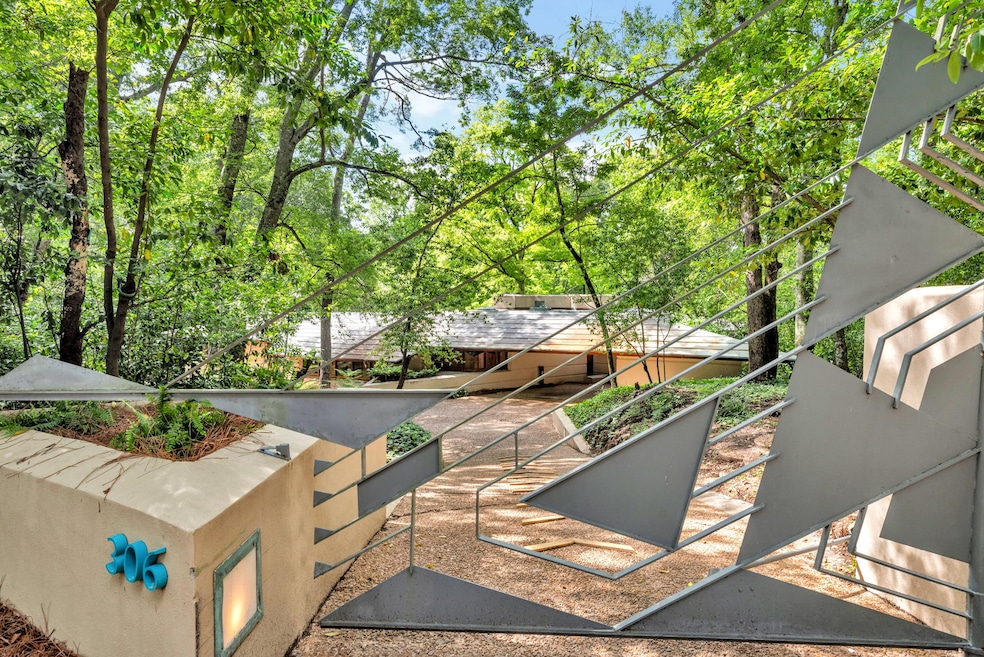
Until recently, not many people had seen much of 306 Glenway Drive beyond the home’s angular gate.
Designed by 20th-century architect Frank Lloyd Wright, the geometric four-bedroom residence had changed hands only once since its 1954 completion for the Hughes family, selling to Robert and Sherri Adams around 1980. Nestled into Jackson, Mississippi’s Fondren neighborhood, the home barely had an online presence, rare for a well-maintained Wright home; even about 65 years after his death, the complex architectural figure maintains an obsessive following.
There weren’t many recent photos of the home — dubbed “Fountainhead’’ — available, especially of its interior; some people didn’t even know the house existed.
“First of all, I didn’t even realize that we had a Frank Lloyd Wright in the state of Mississippi,” said Sotheby’s International agent Douglas Adams; despite sharing a last name, he bears no relation to the sellers. But when the opportunity to represent Fountainhead Residence arose, Adams got up to date quickly, steeping himself in the home’s design and history.
Like most Wright homes, Fountainhead was specified to suit its lot — nearly an acre of sloping land peppered with trees. Wright seemingly pulled the design across its irregular lot like taffy, relying on modules of gently tilting parallelograms. Wright was 81 when he designed the home in 1948, and it bears the architect’s characteristic Usonian moves: Its nearly flat, copper-clad roof shelters the long structure, boasting expansive cantilevered overhangs. The architect also eschewed stud walls, Sheetrock and brick, instead filling the structure with a burnished heart tidewater red cypress and blocky stucco walls that offered ample open living space for his client’s sizable family.

But when Fountainhead changed hands, it needed attention. Three decades of family life can wear a structure down, and Robert “Bob” Adams undertook a sweeping restoration project. Bob was an award-winning architect himself, one with a master's in historic preservation, so he worked deliberately to ensure Wright’s original design could endure.
He cared for the home’s locally sourced wood, original copper surfaces and concrete floors, but, in certain moments, he delicately added modern amenities, including air conditioning. Wright eschewed air conditioning in favor of passive cooling measures, and, while that might work in his native Illinois, Adams said, “Obviously, he never tried to live in Mississippi in the dead of summer.”
Instead of sticking bulky cooling systems throughout, Bob Adams engineered a unit clad in Wright-inspired wood fins, letting cool air flow along the home’s low stucco walls.
The home’s midcentury details called for a careful sale process
When the house hit the market in late May, the sellers moved with the same deliberation Bob Adams used to restore the home.
“There was so much interest,” Adams said. “Overwhelming, to be honest, and we had to really protect not only the integrity of the house, but we had to protect even a lot of nuances inside of the house.” That means no open houses, where careless steps could see visitors trample on the diamond-shaped lights embedded in the floor suffusing corners of the home with a milky glow.
“There were a lot of little things … that we had to really protect,” Adams said.
Some of those little things included detailing and furniture Wright designed for Fountainhead, as he did for most of his residences. Built-ins aside, the home came with a three-section parallelogram dining table, about 16 ottomans, four living room chairs, pairs of interior wood shutters and folding doors — an expansive and largely unique collection worth an estimated $500,000, Adams said, noting that it was a hard number to pin down.
“As far as the value, Sotheby's had a hard time really,” he explained. “There was nothing that had sold that was that particular thing, because they were all very unique to Fountainhead.” Still, their obvious value was enough that Bob and Sherri Adams worried that someone would purchase the home and strip it bare, selling its shutters, tables and seating to buyers around the world.
That meant private showings with vetted buyers, and it took only about four before a couple really fell in love with the home. They just weren’t at a stage of life in which owning and maintaining the residence was feasible, but they had an idea.
What if, those buyers posited, they made a significant donation to the Mississippi Museum of Art? Not a donation for the full list price, but one that might encourage other donors to do the same.
Bob and Sherri Adams gave their blessing, and a conversation with the MMA kicked off by June, just about a month after Fountainhead hit the market.
“In truth, it was a really good fit,” said MMA director Betsy Bradley. For a museum based in downtown Jackson, an urban center in the state, “this was another opportunity to pursue a presence in the community.”
Fountainhead came with practical considerations, like traffic
There are precedents for museums buying single-family homes, Bradley explained.
Crystal Bridges Museum of American Art in Arkansas bought a Wright house in 2014, moving it from New Jersey; New Hampshire’s Currier Museum of Art owns and operates two Wright home-museums, and the Indianapolis Museum of Art owns Eero Saarinen’s Miller House. These peer institutions, and the Frank Lloyd Wright Conservancy, offered MMA resources and advice on navigating the practical details of the purchase.
Fountainhead is “embedded in a residential neighborhood which contains property owners who value their own privacy,” Bradley said. “So, we spent the last couple of months really working with the neighborhood association, the individual property owners in the neighborhood, to work out a memorandum of understanding.”
That memorandum outlines how MMA will operate and manage the home “so as to cause as little intrusion as possible into the daily rhythms of the neighborhood,” Bradley said, while allowing visitors to experience the design fully. Mostly, that means capping and managing traffic, she explained, limiting parking around the home and relying on small shuttles that ferry visitors from the MMA to Fountainhead. MMA also plans to run its tours based on reservations, limiting group size and the number of special events that Fountainhead holds.
But that could come more than a year down the line, Bradley said, following another round of restoration. In addition to the “usual kind of wear and tear that needs to be addressed,” Jackson sits on a thick layer of Yazoo Clay, a shifting soil that can warp foundations, pulling at the seams of Fountainhead’s copper roof and straining its panes of leaded glass.
“We’re looking at a pretty extensive engineering process to stabilize the house first, and then the things you have to think about as property owners,” Bradley said, run-of-the-mill things, like rain and water drainage.
For a museum, homeownership comes with conversations
After a few months of smoothing out the funding and details, MMA officially purchased Fountainhead at the end of November for $2.5 million. Bob Adams died in July at the age of 87, so he didn’t live to see the final sale, but he knew that the museum was interested, Douglas Adams explained. Ultimately, the agent represented both sides of the deal.
For MMA, homeownership comes with a slew of possibilities. In addition to the way a Wright home might make a visitor consider property as art, Fountainhead also prompts people to consider “the ways that we live in our homes,” Bradley said. That might mean examining a space’s indoor-outdoor relationship, which Wright prized, or the ways our modes of living have evolved since Fountainhead was completed.
“It brings to mind what we’ve become accustomed to in terms of our own living spaces, the ways we gather in kitchens and the ways homes function,” Bradley said. Because it’s a Usonian house, one of Wright’s idealized residences, “there’s an opportunity for a conversation about American lifestyles and how they have evolved over the past century.”