
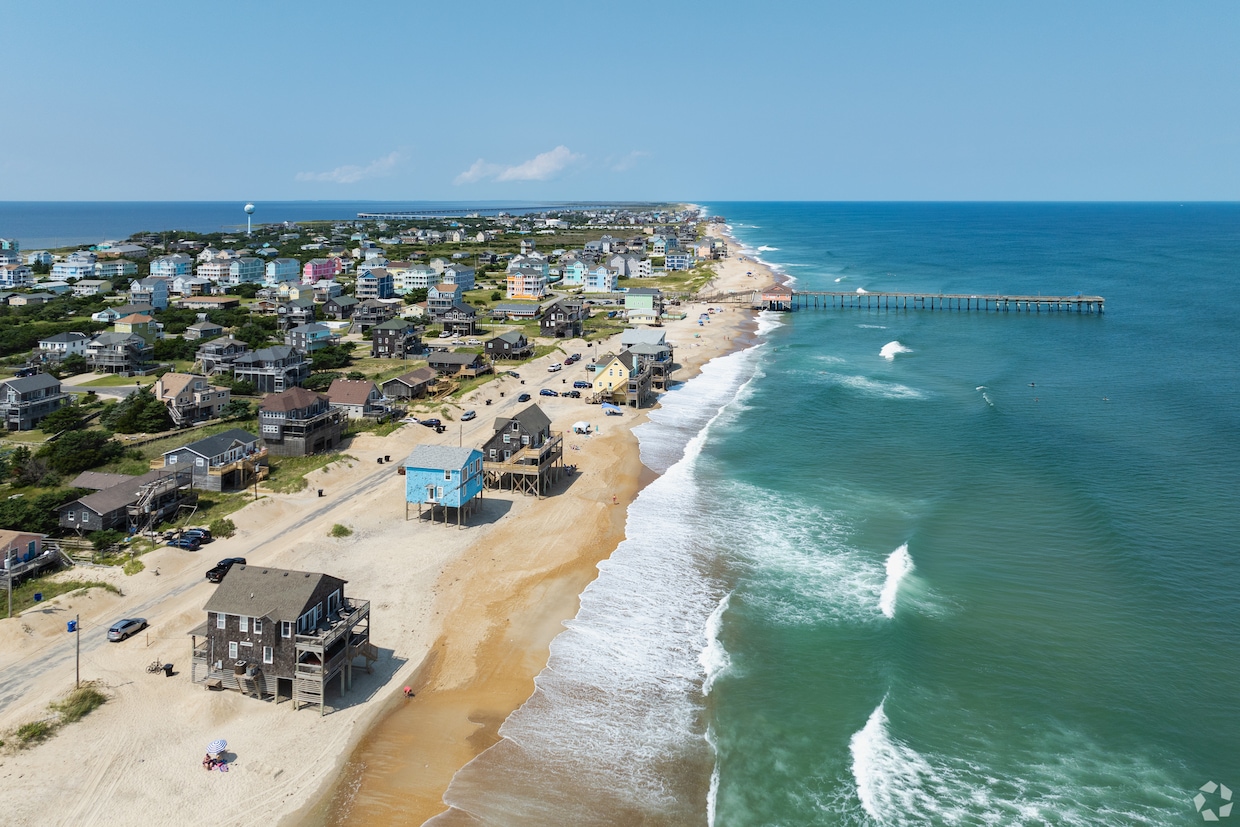
Sixteen houses in one section of North Carolina’s Outer Banks vacation area collapsed this fall because of wind, waves and storms. State officials hope Congress can encourage homeowners to tear down or relocate their properties before more properties fall victim to the sea.
Gov. Josh Stein sent a letter to the House Financial Services Committee last month, urging support for a bill that would amend the National Flood Insurance Program. The legislation would allow owners to collect insurance payments if they remove their houses from the beach, rather than waiting until they are destroyed.
Under current law, after a house falls into the sea, an owner is eligible for up to $250,000 for the structure and $100,000 for anything inside, according to a webpage set up by Dare County, where all the recent house collapses occurred. Twenty-seven homes have collapsed since 2020, the county said, all of them in the Rodanthe and Buxton areas. None were occupied at the time.
“When these houses collapse, they are not just a tragedy for the homeowner. The destroyed houses also spread pollution and debris for miles,” Stein said in his letter.
Cape Hatteras National Seashore has had to haul more than 400 truckloads of debris from fallen houses since September, the governor said.
The issue of beach erosion on the Outer Banks has worsened in recent years, according to an August 2024 report by the North Carolina Department of Environmental Quality and the National Park Service. That’s despite significant efforts to stem the sea’s landward movement documented in the report, from adding sand to beaches to more structural erosion-control projects. Some of the collapsed houses used to be several hundred feet away from the shore, according to Dare County.
The legislation pending in Congress would allow the federal insurance program to reimburse owners for up to 40% of the cost of demolishing or moving a house, or up to $250,000.
“As currently structured, the NFIP provides a perverse incentive to homeowners, where it can be in their financial interest to avoid taking proactive action to protect their own property and their community,” Stein wrote.
Rep. Gregory Murphy, Republican of North Carolina, filed House Bill 3161 last May with co-sponsorship from legislators in Maine and Virginia, two other Atlantic Coast states. The Financial Services Committee has not taken any action on the bill.