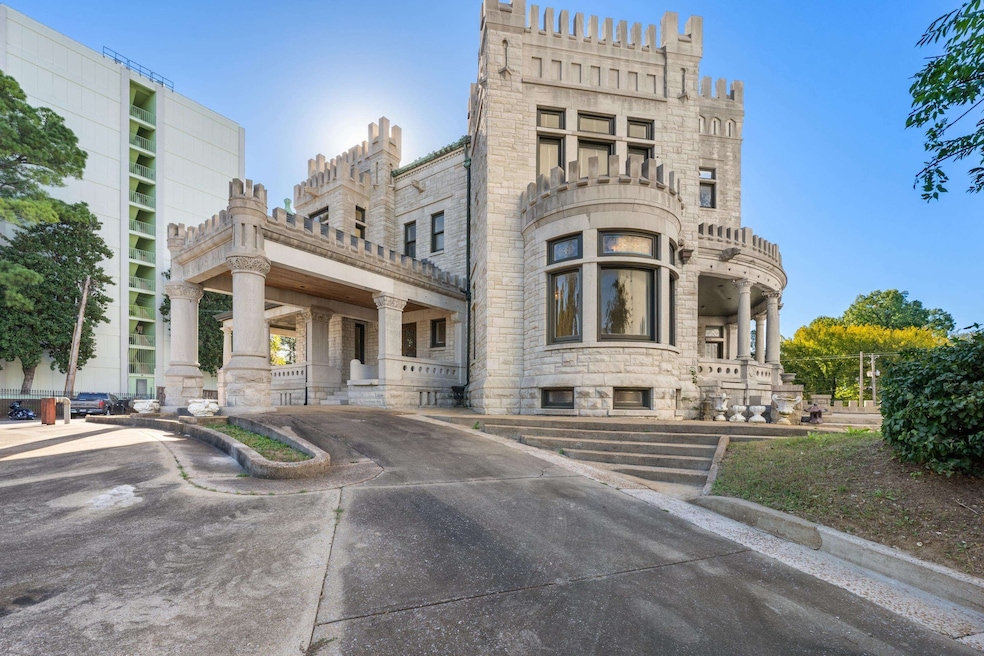
One of the more dramatic residential addresses in Memphis, Tennessee, is Ashlar Hall, a prominent local developer's creation and home for nearly half a century. It’s now for sale after a million-dollar-plus renovation, with potential use as a home, a wedding venue or another creative purpose.
When Robert Snowden moved into the castle-like six-bedroom house in 1896, it sat on a large property in a suburban environment. He was one of several developers who parceled up the surrounding Central Gardens neighborhood over time; while there are historical single-family houses nearby, the immediate area now also includes a number of high-rise apartment buildings. The home comes with 40 parking spots.
Beyond the $3 million asking price for 1397 Central Ave., it could take a buyer some $200,000 to make the more than 11,000-square-foot property comfortable to live in, listing agent Garth Ward of Park Place/eXp Realty told Homes.com. The kitchen and bathrooms, for example, aren’t quite up to residential standards.

“It would be very strange for someone to want to spend $3 million and live there. But you never know, and that’s why we’re shooting all angles,” he said.
Developer Juan Montoya acquired the property at auction in 2016 and spent the past decade restoring it, Ward said, with careful attention to its historical appearance. The property has been on the National Register of Historic Places since the 1980s.
The nomination for the register called Ashlar Hall an example of the Eclectic movement popular at the end of the 19th century, which mixed elements of various architectural styles. Here, the builders incorporated Norman, Gothic, and Renaissance elements, as per the nomination. The name "Ashlar" derives from the type of stone that envelops the house; it was imported to the site from Indiana, Ward said.
The house deteriorated, then got a revamp
Snowden was related to John Overton, who helped map the city’s first streets in 1816. The developer and his business partners built several subdivisions in what became known as the Midtown section of the city, according to the National Register nomination. Snowden was also involved in building the new Peabody Hotel in 1925, one of the most prominent buildings in downtown Memphis.
After Snowden died in 1942, the Central Avenue property became a restaurant. More recently, an eccentric figure and frequent Memphis mayoral candidate named Prince Mongo owned it for a couple of decades before losing it over unpaid taxes and environmental issues. At the time Montoya bought it, Ward said, the roof was caving in and the stone exterior and millwork inside needed extensive repairs.
“[Montoya] does a lot of projects in the city, but he took this one up as a passion project,” Ward said. “Most of his projects take 60 to 100 days. This one was obviously very different.”
The house includes four bedrooms, including the primary, on the second floor, according to the National Register nomination, with more sleeping areas in the attic, where servants would have stayed in Snowden’s time.
Ward said he’s excited to see the property restored and available for new uses, but he’s also disappointed that many Memphis residents he’s spoken to don’t see its potential.
“A lot of them talk about how they want Memphis to be a better place, but when something happens that objectively makes Memphis better, they want to tear it down,” he said. “They want to say the area’s not good, that nobody will want to buy that. I think it’s partially connected to the Prince Mongo era, but also purely that people like to speak negatively about Memphis.”