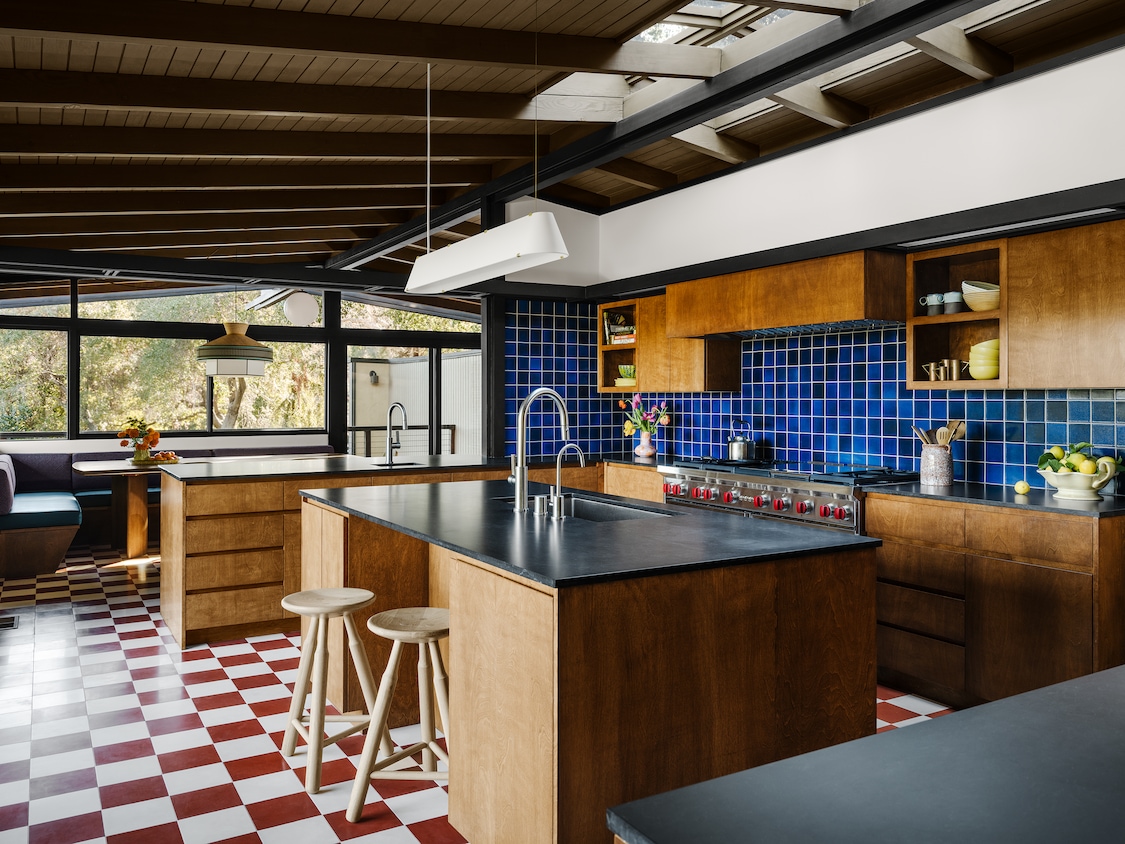
The holidays often mean hosting — and with hosting comes the inevitable scrutiny of your space. Family members squeeze past as you pull the turkey from the oven, and the kitchen feels smaller as the island becomes crowded with guests deep in conversation.
To help identify ideal kitchen designs that make holiday hosting easier, Homes.com asked three professional designers to share the materials, appliances, colors, and layouts they would personally choose for their perfect kitchen.
With an unlimited budget, here’s what they said, offering homeowners tips they can try themselves:
What’s your favorite layout for a hosting kitchen?
Bob Zuber, Morgante Wilson
Designing a kitchen starts with the layout, “first and foremost,” said designer Bob Zuber of Chicago-based Morgante Wilson. “Then come the views out the window, the adjacency to the garage to bring in groceries or the butler’s pantry. We’re thinking of the layout, location of space, then start to layer on ideas.”
The so-called kitchen work triangle is a principle that designers follow when laying out a kitchen, referring to the location of the sink, refrigerator, and stove. Ideally, the three components are arranged in a triangle, which becomes the workspace — and nobody should be walking through that workspace, said Zuber.
With that in mind, he would suggest a huge island that stretches out to form an L- or T-shape with seating, allowing visitors to casually chat while facing one another.
Leah Ring, Another Human
Leah Ring of Los Angeles-based Another Human likes when cabinetry wraps itself around a center island in a U-shape, with an island measuring about 4 feet by 8 feet, enough for at least four comfortable chairs.

“I don’t want an island the size of a studio apartment. I think they can get a little bit ridiculous,” said Ring. “But it is sometimes nice to have your main sink on the countertops and a prep sink on the island, or vice versa, just so you have two sinks going in the kitchen.”
For appliances, a quick tip from Ring is to place a wine or beverage fridge at the edge of the kitchen so that guests are barely entering the kitchen to grab a refreshment.
Gladys Schanstra, Drury Design
The layout is similar to the choice of Glen Ellyn, Illinois-based Gladys Schanstra, owner of Drury Design. But rather than an island, Schanstra might opt for a “huge county wood table” that serves as an island or dining table, while all other functions and workspaces live on the perimeter cabinetry surrounding the table.
But something Schanstra would consider is creating an extra-wide space between the island and perimeter cabinets so guests passing by can stay out of the host’s way.
“I have about 6 or 7 feet [between], and I remember thinking, ‘This is so far out.’ My family and I got used to it quickly, so when we go to smaller spaces that are perfectly normal, we think, ‘Hmm, this is really small!’”
Formal dining room or not? What about a scullery kitchen?
A breakfast nook or casual dining space within the kitchen footprint is a must for the designers in their ideal kitchens. A formal dining room, on the other hand, is up to the type of host, they said.
Leah Ring, Another Human
“I love a breakfast nook situation or an eat-in kitchen. It feels cozier,” said Ring. “I like the ability to have people cooking in the kitchen and speak to people sitting down at the table.”
Ring is in the camp of no formal dining room, and on the West Coast, where Ring works, a butler’s pantry, also called a scullery or messy kitchen, would be hard to fit into the limited square footage. And as a casual hoster, the designer wouldn’t have it as a need.
Gladys Schanstra, Drury Design
Schanstra, on the other hand, loves a formal dining room and a scullery to house her extra plates and flatware, as well as space for additional appliances. This smaller space is also one where more design risks can be taken.
“I’ve always loved pink. … That’s going to be incorporated in a very glossy finish, maybe with some brushed bronze hardware with glass and some wallpaper,” Schanstra told Homes.com. “I love good color.”
Bob Zuber, Morgante Wilson
In Zuber’s projects, a scullery becomes vital for homeowners who formally host with wait staff or caterers.
These spaces need to be easily and quickly accessible from dining, though, notes Zuber, so food doesn’t get cold on its way to the dining room. A scullery could also double as a bar.
“A little trick we’ve done is the bar is between the living room and kitchen and dining room, but one side of it can open up into the bar as a serving counter, while for the rest of the year, it’s closed off,” said Zuber.
Zuber is a designer who casually hosts and says many of his clients opt for a dining area within an open-concept great room.
What aesthetic choices are you making?
Really, the fun part in kitchen design comes from the aesthetic choices, such as flooring, cabinetry, colors and materials. Some materials can offer low maintenance to help with heavy use, while some designers would take looks over performance.
Bob Zuber, Morgante Wilson
Zuber favors a good-textured tile backsplash and a resilient quartz countertop, “I personally have [quartz] in my kitchen and love it.” But the tile should stay on the walls if all decisions were up to him.
“If you’re doing a lot of cooking, wood floor is just easier on your back,” he added.
Rather than bringing in interest with color, Zuber’s kitchen would instead mix natural wood and painted cabinetry — maybe a warm white or dark blue — with metal accents. He’d use more storage in the base cabinets and limit the use of upper cabinetry to make way for lots of windows.
Leah Ring, Another Human
Ring’s style focuses on fun with unexpected color combinations. In her personal kitchen, she has painted cabinets a bright, bold color, and would do the same in either a light celery green or ox-blood red.
She might opt for a dark, moody soapstone countertop: “For clients that don’t want to see a patina … I often go with a quartz countertop just because they’re so durable. But for myself, I would definitely want marble or natural stone. … I’m fine with the wine stain or acid marks, I think it’s so beautiful to see the wear over time.”
Appliances would be panelized and hidden behind the cabinetry so as not to disturb the swath of color, with potentially fun hardware, even custom powder-coated in a unique shade, if the space called for it. Then add a tile backsplash up to right below the upper cabinets for more opportunities to play with color and pattern.
Ring’s hot take: Linoleum floors — in a “wild, vibrant” color, of course.
“Linoleum gets a bad rap,” she said. “You get really cool colors, it’s very easy to clean. I would do the roll linoleum rather than the tiles, so you get a nice smooth surface. … It’s nice and soft on your foot.”
Gladys Schanstra, Drury Design
Spending a lot of time in Greece, Schanstra has seen 50-year-old marble countertops with divots from her step-grandmother's decades of rolling dough. Choosing marble would be a must in her ideal kitchen.
“It’s all patinaed over the years and it’s beautiful, and it’s great for baking and whatever else you’re making,” she said. “That’s more important than being worried about it being pristine. It keeps a space warm.”
Schanstra would do the all-out pink scullery but keep her main kitchen covered in warm woods and tile with a 3D relief for a “pop of interest.”
What fancy extras would you include?
When budget is no consideration in designing a project, everyone would throw in a few extra gadgets or extra luxe additions. For these designers, they range from specialized plumbing fixtures to comfy corners.
Leah Ring, Another Human
“I personally would like a pot filler over the range. I know that it’s not used all that much, but I love pasta and I just think a pot filler is cool,” said the California designer.
Ring calls her next gadget choice a “dream,” and it’s also high on Schanstra's list: a Zip Water tap, a faucet that shoots out chilled, sparkling or boiling water.
Gladys Schanstra, Drury Design
“You can do hot, cold and you can infuse carbonation, so you can make your own sparkling,” she said. “I have a SodaStream, but this one is plumbed in and dedicated.”
To make the beverage area pop more, Schanstra would place a clear ice maker here or in the scullery.
Bob Zuber, Morgante Wilson
“Another thing that’s super popular are fireplaces and sitting areas in kitchens,” said Zuber. “It’s very indulgent, but we like to call them Starbucks rooms. … It’s the cozy fireplace with two comfy chairs. It adds a layer of ambiance.”