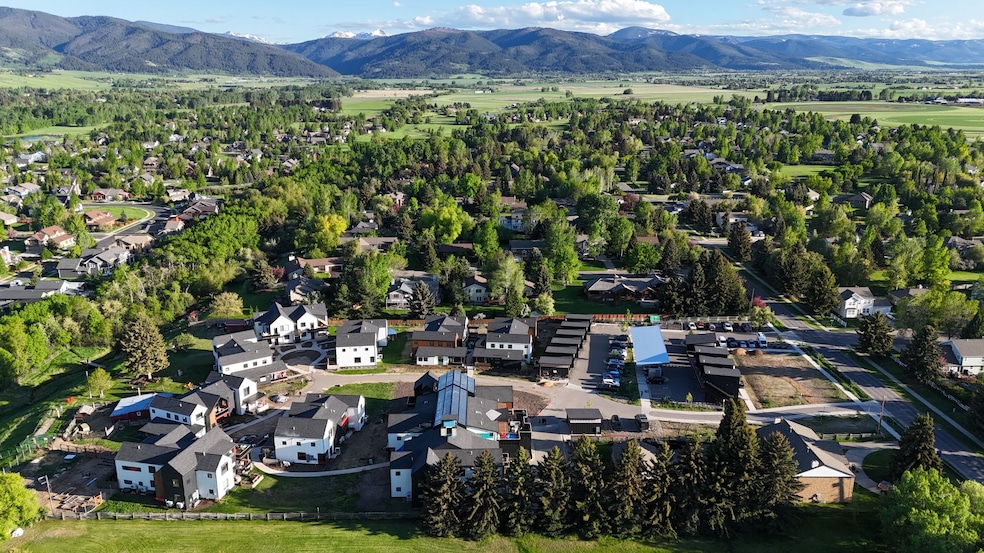
A few years ago, Paul House was at a transition point in life, trying to decide where he wanted to live next.
The Bozeman, Montana, native wanted to remain in his hometown, and he knew what traditional single-family living might mean for his personal lifestyle.
“I’m not a huge extrovert,” House said. “If I’m on a street of single-family homes, I’m going to watch people go into their garage and that’s the last time I’m going to see them. I wanted more of a social network than that.”
The 58-year-old entrepreneur wasn’t religious, but he craved the kind of instant community and ready support that faith groups can offer by gathering members in proximity. So, when House heard that Bozeman was on the brink of getting its first cohousing community, a compact neighborhood of privately owned homes with shared common areas, he was interested.
Although the net-zero neighborhood was still roughly a year away from completion, it was almost entirely pre-sold through word of mouth. Real estate agents weren’t involved, House said; the units just sold themselves, with some buyers even moving to Bozeman specifically for this project.
But by the time Bozeman Cohousing popped on House’s radar, there was only one unit still available, and he was second in line for the chance to make a deposit. He got lucky, and when he got word that the two-bedroom residence was all his, he wrote a check with “no hesitation,” he said. “Zero.”

'It’s like a return to this idea of the village'
When House closed on his cohousing residence, he’d scooted in right at the end, leapfrogging about five years of meetings and planning. All that planning began in May 2019, when a kickoff meeting brought together founding members and individuals curious about cohousing across the city. That included Cadius Partners, the developer-builder, and Studio Co+hab, the project architect.
“In my experience, people kind of have a bit of a fuzzy understanding of co-living or cohousing,” said Erik Bonnett, co-founding principal of Studio Co+hab. The architect, who also lives in Bozeman Cohousing with his family, noted that sometimes people think of communes when they hear the term "cohousing," but many U.S. cohousing neighborhoods operate more like condominiums, where people own their spaces and share common areas.
In cohousing, he detailed, “people come together with the intention of knowing, and to some extent caring about, their neighbors. In a lot of ways, it’s like a return to this idea of the village.”
It’s a characteristic that might feel familiar to residents of older U.S. neighborhoods, Bonnett said, but “a lot of the neighborhoods that we’ve built in this country in the last 50 to 80 years have really focused on design for the automobile at the expense of design for the human.”
The project is Montana's first net-zero cohousing community
By October, the founding Bozeman Cohousing group had enough backing to make an offer on a 5.3-acre lot about 2.5 miles from the city center, and the design process began just a few months after, kicking off with a workshop led by Katie McCamant from the organization Cohousing Solutions in January 2020. The group closed on the land in February 2020, at the beginning of an obviously fraught pandemic-era moment for the building industry.
“It’s like, lumber costs twice as much as it did the week before,” Bonnett said. This meant the design team had to make changes in real time as materials shot out of financial reach, finding windows, sheathing, and finishes that were high performing without exceeding the budget.
Still, the group continued, hosting design workshops, submitting plans for city approval, and breaking ground in February 2022. In addition to resident input sourced from these design workshops, the cohousing community was shaped by its emphasis on sustainability: It’s all electric, and it’s the first net-zero cohousing project in Montana.
While such rigorously sustainable designs have ballooned in U.S. residential interest, they’re often focused on custom home projects, the architect explained. It’s rarer to find market-rate housing performing at quite the same scale.
The Studio Co+hab design team relied heavily on BEopt, a government-funded energy optimization tool. And, while it doesn’t have a super shiny user interface, Bonnett noted, it works.
That net-zero backbone helped shape the project design and massing: four so-called pods arranged along teardrop cul-de-sacs. In addition to community spaces — guest rooms, a communal kitchen, coworking spaces, and more — the building shelters about 100 residents in 43 units, ranging from 576-square-foot studios to 1,450-square-foot, three-bedroom residences. Thanks to city grants, two of the units are permanently affordable.
One thing the project shows is that there’s a market for this kind of thing in Montana, Bonnett said. “It’s not way out of range of what people can build for.”
Some eventual buyers, Bonnett said, had even given up on purchasing a home. “And then this popped up, and they were like, ‘Wow, I can afford it.’”
When it comes to pricing, "cohousing homes typically cost more than other new condos or townhomes," thanks to the shared amenities, according to the neighborhood's website. When the development neared opening in 2023, units were priced from $300,000 to $700,000, KBZK reported. Residents also pay monthly dues for maintenance, community investment, and utilities, including cable and internet. House pays about $375 a month, which he thinks is "probably in the middle of the cost ranges."
Visitors and residents can drive around the neighborhood if needed, but cars mostly stay near the entrance; the design nudges people to walk around, running into neighbors as they go.
That car-free connection was a priority for Carol Thompson, a retired professor of economics and international finance.
“One of the things that I was looking for was the control of cars,” Thompson said.
Thompson was involved in the cohousing movement for seven years — four years spent trying to get a community off the ground in Flagstaff, Arizona — before landing in Bozeman.
“I’m a lifelong activist in various issues of social justice, and I think Americans need to change the way they live,” said Thompson, now in her 80s. “So, for my generation, that means not aging in a big, old house that I’m rattling around in, but seeking out new relationships and definitely downsizing.”
For Thompson, that means downsizing from a three-bedroom home she lived in with her late husband to a 900-square-foot, two-bedroom property in Bozeman Cohousing.
Reaching consensus is often worth the effort
Sometimes, House is still amazed by the project — which in addition to the material price hikes, faced labor shortages — actually came to fruition. “It was just miraculous that this thing isn’t sitting here half-finished as an eyesore.”
On top of that, he marveled that cohousing didn’t take off in Missoula, Bozeman’s more liberal-leaning neighbor, first. “Missoula is the progressive town,” he noted. “They’ve tried cohousing at least two different times, and it hasn’t taken off — and that’s normal.”
Cohousing projects hinge on a mix of luck and strategy — those initiating the project have to find the right land and the right people willing to buy into the lifestyle early on, amassing enough funding to break ground.
Still, life in Bozeman Cohousing isn’t for everyone. In some ways, it’s a life of continuous meetings. The community operates on consensus, from weed treatment measures to solar installation.
“Even some of my close friends would never make it,” House said with a chuckle. “There are too many group decisions needed, and that’s not for everybody.”
Consensus rule is also an untapped muscle for Americans accustomed to the rapidity of majority rule. It’s hard work, Thompson pointed out, and consensus “takes what feels like an infinite amount of time. But once you have the decision, the implementation is easy.”
“At times it drives every single one of us crazy,” she said, “but I think I can say that most everybody in our community now agrees that it’s worth the time and effort.”
The community has residents from different walks of life
The social reality is a key aspect of how Bozeman Cohousing exists, both Thompson and House noted. For Thompson, it’s about “90% excellent.” Sometimes disagreements arise during meetings, but that is part of living in a community that blends people together from different ages, backgrounds, and walks of life. Thompson helps watch her neighbors’ dogs during travel season and has earned the nickname “Cookie Carol” thanks to the ready boxes of freshly baked treats she has available.
“For a senior to have infants around and 1-year-olds knocking at the door and a bunch of dogs, it’s very nice,” she said.
House cannot see himself ever leaving the community. Since moving in nearly a year ago, he’s helped install solar panels and works in the neighborhood barn, where the community cares for 24 chickens and three medium-sized goats: Snickers, Trouble and Nelly. When the cohousing community held a dedication ceremony earlier in the year, he found himself getting emotional.
“It’s a great feeling to feel like it’s having that much effect on me,” he said.
“I think once people experience the kind of social network that’s created by something like this, that would overshadow and quell their fears. It’s just different in some ways, and that’s enough for people to turn away.”