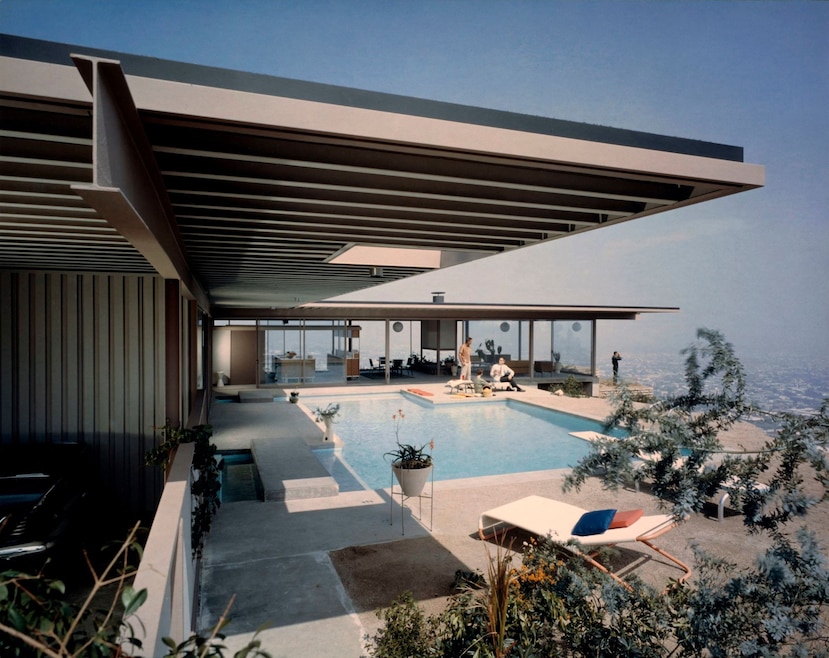
You might recognize The Stahl House from a photograph: Two women sitting in the corner of a window-wrapped home cantilevered over the Hollywood Hills, the streets of Los Angeles glowing in the background.
Using a seven-minute exposure, architectural photographer Julius Shulman shot the black-and-white photo in 1960, capturing something about the home’s striking design and the dreams people might have about L.A. in a way that cemented both Shulman’s photograph and the house itself as midcentury icons. In 2016, Time magazine named the photograph one of the world’s most influential, and in 2013, the National Register of Historic Places placed The Stahl House on its registry.
“I don’t know of another iconic house that would be more significant than The Stahl House,” said broker William Baker, architectural director for The Agency.
For the first time since its 1959 completion, The Stahl House, also known as Case Study House No. 22, is on the market. Baker has listed the 2,200-square-foot home, situated at 1635 Woods Drive, for $25 million.

“After 65 years, our family has made the heartfelt and very difficult decision to place The Stahl House on the market,” Bruce and Shari Stahl, the home’s current owners, wrote in a statement. The pair grew up in the home commissioned by their parents, Buck and Carlotta Stahl, and, over the past 17 years, have opened it to the public for tours, using the revenue to maintain and restore the 65-year-old structure.
Even as Case Study House No. 22 is for sale, the Stahls are continuing tours.
“This home has been the center of our lives for decades, but as we’ve gotten older, it has become increasingly challenging to care for it with the attention and energy it so richly deserves,” Bruce and Sheri Stahl said. “The time has come to identify the next steward of Case Study House No. 22 — someone who not only appreciates its architectural significance but also understands its place in the cultural landscape of Los Angeles and beyond.”
Pierre Koenig relied on steel and glass to preserve views
Construction on The Stahl House, a Pierre Koenig design, began in 1957.
Buck and Carlotta Stahl asked the American architect to scheme out a residence for the sloping land they had purchased for $13,500 three years earlier. The empty, rocky and steep West Hollywood land proved a challenging site, but it offered seemingly endless views of the city below.
“Buck kept saying, 'I don’t care how you do it, there’s not going to be any walls in this wing.' We didn’t want to lose any view anywhere,” Carlotta Stahl told Los Angeles Magazine in a 2016 interview.
The solution? Steel framing. Although largely confined to industrial structures at the time, Koenig sketched out a two-bedroom, two-bathroom design that relied on the rigid material to frame expansive windows wrapping the home, preserving each priceless sightline. The cantilevered plan was accepted into the Arts & Architecture Magazine Case Study Program, becoming Case Study No. 22, and was completed in about 13 months.
“It is not readily apparent to most people how remarkably ahead of its time the architecture was for 1959,” states the Stahl House website. “Elegantly simple looking, the house is all glass on three sides. It took the largest pieces of glass commercially available at the time to accomplish this task, which had lots of errant risk.”
Although the innovative Case Study House program resulted in 36 designs and 25 built projects, including The Stahl House, there are only about 20 such homes still standing, Baker explained. Many were demolished, and several of the remaining have been radically reworked.
“My understanding is the Stahl House is the remaining [Case Study home] with original ownership,” he said, and the family’s decision to sell it is deeply considered.
Despite its architectural-icon status and its photographic pedigree, “it’s a family home,” Baker said. “It’s a home that five people lived in.”
This relationship between the photo and a quotidian residence is also part of what makes this property unique, Baker pointed out. “The pure juxtaposition of this glamorous shot, which kind of represents the optimism of Los Angeles, and then a family of five [living there] … I mean, that, to me, is what makes it such a singular, unique story.”
Finding the right steward for an architectural icon
Locating the ideal buyer for such a home is a delicate process.
“It is profoundly important to us that the new owner honor the legacy of our parents, Buck and Carlotta, respect Pierre Koenig’s vision and be committed to protecting the house today and far into the future,” Bruce and Sheri Stahl said.
That means a careful buyer identification process, Baker said. “We’re working very strategically to do our best to vet the person who would be someone who would carry the tradition of the property.”
That means carrying on its legacy as a family house, he detailed, while honoring its public-facing side.
The Stahl family has run private tours through the home since 2009, Baker explained, a rarity among many L.A. architectural icons that remain private residences.
“I think, ideally, they would look for someone who would hopefully keep it open to the public,” he said.