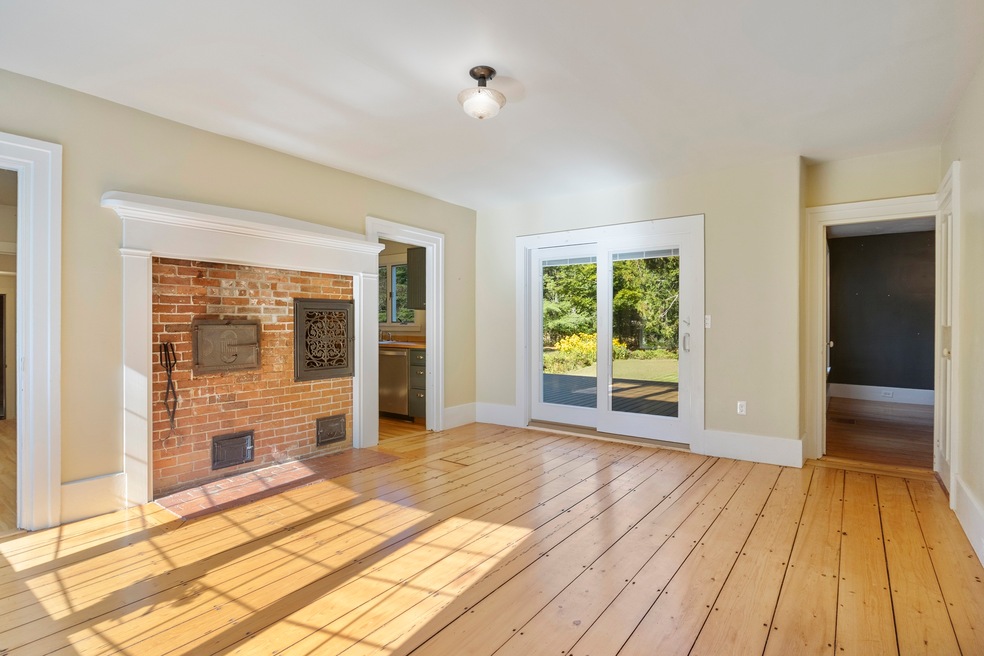
If you are a sucker for wood floors, the planks that run throughout the 19th-century farmhouse at 162 Merrill Road in Pownal, Maine, might make you jealous—especially the flooring at the home’s heart.
Secured with the original nails and with gaps left by the builders to allow the wood to expand and contract during the seasons, the wood flooring boasts a burnished orange hue, not unlike the skin of a pumpkin. That distinctive color gives the wood its name: “Pumpkin pine.”
“When I’m holding an open house, that’s usually one of the first things that someone will say when they step into the home, ‘Oh, my god, I love this flooring,’” said Peninsula Real Estate agent Rebecca Kingsley Sewall. She has listed the home for $1.24 million.
To Sewall, the home’s original pumpkin pine boards — definitely found in its sitting room and possibly stretching into the living and dining rooms — are an element that “ought to be really valued and honored because it’s not something you can replicate,” she said. Alongside her husband, the agent restores historic Maine homes and has a weakness for this flooring that “signals a specific sense of place and history.”
Wood that's 'a written documentation or story of the home'
Found predominantly in New England, authentic pumpkin pine flooring is old-growth Eastern white pine that its original creators painstakingly aged. According to the Northeastern Lumber Manufacturers Association, woodworkers treated the planks over a period of decades to draw out the custardy hues, aging the pine between layers of straw. Every couple of years, workers would flip and wipe the boards before tucking them back in with fresh straw for a total of 70 years.

“As the time required for the wood to change color took more than two generations, the people who started the project were unlikely to see it turned into flooring or furniture,” educator Richard Macintosh remarked in a 2003 essay. “It was something they did for their posterity, descendants who they wouldn't live to see.”
The wood is also a softwood, Sewall noted, so flooring made from pumpkin pine retains the scars and marks of the lives it has supported. In a culture that increasingly fetishizes perfection — vinyl flooring, hardwoods treated to withstand dog toenails and roughhousing — a material allowed to show its wear becomes “kind of like a written documentation or story of the home,” she said. “I really like that contrast to modern values where we want perfect, we want it all uniform, and we want it now.”
'A flooring that does not need to be replaced or improved'
Although some finishes and stains attempt to mimic the orange finish characteristic of pumpkin pine, it’s impossible to replicate exactly. There remains, however, a market for reclaimed pumpkin pine boards, which some homeowners find in their attics or remove during gut renovations.
Even in Maine, it’s “unfortunately, not very common” to encounter pumpkin pine in a listing, Sewall said. There’s a dwindling pool of available planks — you can’t replicate the thick trunks of old-growth wood, so making more pumpkin pine is a no-go — and some homeowners who have pumpkin pine don’t always recognize the rarity of the material. If they keep the wood but don’t like its distinctive patina, they might refinish it, erasing decades of aging in one fell swoop.
For all its rarity, however, quantifying the value of pumpkin pine is difficult, Sewall said. To some extent, the flooring’s beauty lies in the eye of the beholder, so if the feature attracts, it holds value. But on a practical level, “I would treat it as a flooring that does not need to be replaced or improved,” she said. In other words, one possible concern crossed off a potential buyer's list.
“The beauty about pumpkin pine is [you] can leave it alone,” she said. “Let it tell its story and the history of this place.”