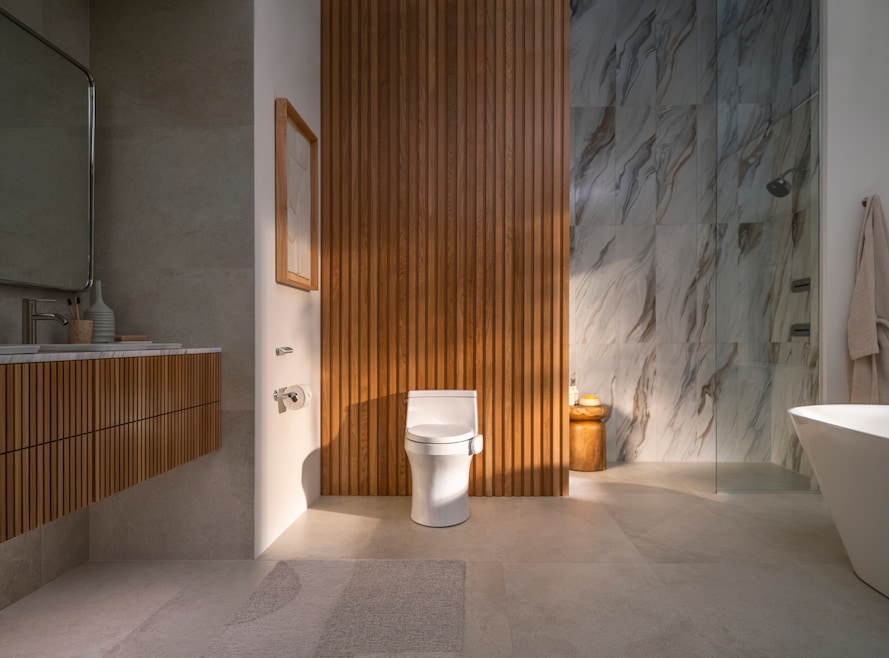
A well-known plumbing hardware company is looking to what its leadership calls a “critical area” in the wellness space: “human waste.”
Inspired by the dominance of digital health — which has users wearing rings, watches and more to track activity from resting to roused — Kohler has launched a camera that monitors the goings-on in your toilet bowl under its new Kohler Health division. The “Dekode” device retails for $599, with monthly subscriptions to the Kohler Health app that provides the stool analysis, ranging from $6.99 to $12.99.
It’s a price that Kohler Health says reflects the knowledge everyday users could gain from Dekode. The device aims to offer “a key area of insights that people could be getting to be able to optimize their health on both a daily basis and ... help them live much better in the future as well,” Kash Kapadia, CEO of Kohler Health, told Homes.com.
There are other toilet bowl cameras out there. Austin, Texas-based startup Throne, for one, offers a pod-shaped toilet tracker that retails for about $400, with a monthly app membership of $6.

Kohler's oblong white pod is reminiscent of an overgrown AirPods case and clips onto the side of the toilet. “One of our key design principals was that we wouldn’t require people to handle their waste,” Kapadia said.
Instead, the device deploys a four-camera optic array — computer vision and spectroscopy — to assess stool in real-time, monitoring a user's hydration levels and gut health, the company says. That combination also allows the device to alert the user to blood in the stool, Kapadia said, with the computer vision detecting anything red and the spectroscopy deducing what that red actually is.
“So, we’re able to detect hemoglobin,” he said. “That allows us to be much more accurate because we’re able to distinguish between ketchup, for instance, and real blood.”
“I think right now no one is really waking up and saying, ‘I really wish I could track … my bathroom behavior,' ” explained Nora Tophof, Kohler Health’s executive director and head of business, likening it to the time before the Apple Watch, a piece of wearable tech that has made tracking everything from steps to sleep ubiquitous. Kohler Health trained the device on more than 850 U.S. users.
“We do feel confident that people are, in fact, willing and eager to start tracking this,” Tophof emphasized.
Kohler Health also emphasizes the security of its product, attempting to alleviate concerns about privacy violations related to a user’s personal health data. A buyer can opt for a wall-mounted remote that authenticates users via fingerprint, beginning and ending Dekode sessions.
“Most people get this kind of insight once a year,” Kapadia said.