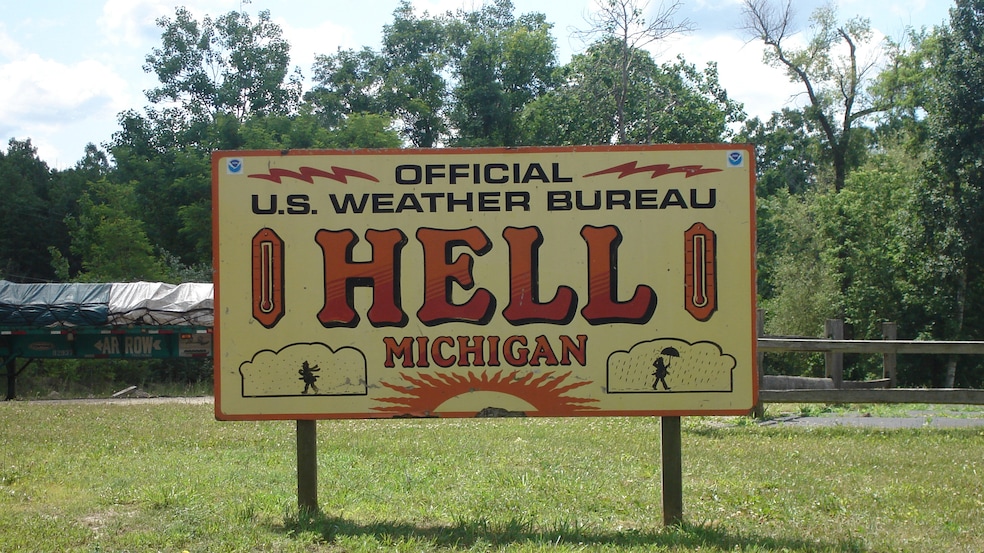
From Truth or Consequences, New Mexico, to Sleepy Hollow, Illinois, and even Hell, Michigan, these eerily sounding towns seem tailor-made for Halloween — but their origins are far less spooky than their names suggest.
It’s supposed to be Caspar
Although the name suggests that this Wyoming city is home to the friendliest ghost around, its origin actually stems from a clerical error.
With a population of 58,823, according to 2024 data from the U.S. Census Bureau, the city of Casper, located in Natrona County, was named after Fort Caspar in the 1860s.
The fort was “renamed in 1865 to honor Lt. Caspar Collins, who died in the Battle of Platte Bridge during a conflict with Native American tribes,” according to the Natrona County website.

“When the town was officially recorded, a frontier Army clerk misspelled ‘Caspar’ as ‘Casper,’ and the name stuck,” the county said.
Alisha Collins, a real estate agent with eXp Realty and a resident of Casper, said the median sales price in the area is about $385,000.
“I've been here for over 20 years,” Collins said.
She described the residential housing market as "kind of hot and cold,” Collins said. “Average days on the market from list to close, we do it a little different here than most places, is about 72 to 75 days.”
While people in the community and prospective buyers find the town’s name humorous, many locals have another nickname for the place.
“A lot of people say, ‘Windy City,’ because it’s so windy here,” Collins said. “I think that's more common than the paranormal hotspot that I've heard it called before.”
She did acknowledge selling a house people thought was haunted, though she and the owner never personally experienced any spirit sightings.
It’s not that Sleepy Hollow
Though incredibly similar to the town in New York, according to Amy Foote, a real estate agent with Compass, this Sleepy Hollow has its own history.
With a population of 3,137, according to 2024 U.S. Census data, Sleepy Hollow was originally bought as a farm in 1953 by Floyd T. Falese, according to the city’s website. It was established as a village in 1958.
“He farmed the land briefly, acquired additional properties and then began subdividing the area to create an upscale housing development that was first marketed as Sleepy Hollow Manor,” the city said.
Falese rejected turning the area into a typical development and instead hired a landscape architect to help him develop it, while preserving the greenery in the area and “the Sleepy Hollow concept of good living.”
Foote has been a resident of the town for 27 years. She stated that the median sales price is approximately $450,000.
“It's still a very hot market out here,” Foote said. “Properties are still [attracting] multiple offers. Values are rising. Inventory levels are still low, higher than they were a year ago, but still pretty low.”
Due to the city’s unique development, Foote said there are no fences or sidewalks, and everyone relies on septic tanks. “You've got to like big lots, you've got to like looking both ways and seeing nothing but grass and no fences and nothing separating you.”
She explained that when people look to buy in Sleepy Hollow, they love the fun feeling of the city and often confuse it with the other one.
“It is in part named after the book" The Legend of Sleepy Hollow, she said. “There are characters in the book that streets are named after in the town.”
This Sleepy Hollow is also a destination for Halloween. Foote said a large event celebrating the holiday is held each year in the middle of the town.
“At dusk, they light off a huge bonfire, and the Headless Horseman rides through town,” she said.
This is a tradition also performed for students at the elementary school and something Foote remembers watching fondly with her children.
The literary figure is even on the town’s police badge.
“It might be a town with a scary-sounding name, but it's an awesome place to live,” Foote said.
People come for the history, stay for the small-town feel
Tombstone, Arizona, known for its Wild West history that inspired a 1993 film of the same name, has a population of 1,382, according to 2024 U.S. Census Bureau data.
The city was founded by Ed Schieffelin, who discovered silver in the area in 1879, according to city historians. Schieffelin was warned to be cautious in the area and that the only thing he would find on his prospecting adventures would be his tombstone.
Schieffelin found enough silver to start his own mining enterprise, which he named “the Tombstone.” Over time, a city was built around the mine and adopted the name.
Real estate agent with Keller Williams Southern AZ, Sam Franko, a Tombstone resident for eight years, said the median sales price is around $249,00.
“We're trying to keep things affordable for the people that want to actually live in Tombstone,” Franko said.
Many people are relocating from other parts of Arizona into Tombstone, according to Franko.
He said it seems people from outside the state are moving into the big cities of Arizona, prompting those people to pursue the state's more rural side.
So, do the out-of-towners know about the city’s unique name?
“Of course, they all know and have some affinity for the Old West and Tombstone,” Franko said.
Many people attend the town's annual Helldorado Days, which happens every October, Franko said.
“We’ll have up to 500 to 7,000 people in town,” he said. “They'll all be dressed in 1880s attire, and there’ll be stagecoach rides and gun fights.”
For Franko, the best aspect of being a Tombstone resident is living in a small town with good people.
Unusual consequences to this town's name origin
The population of Truth and Consequences, New Mexico, is 5,942, according to U.S. Census data.
The town, located in Sierra County was originally called Hot Springs due to it being surrounded by hot springs along the Rio Grande River. It was renamed in 1950, according to the Sierra County website.
The name change was “part of a publicity scheme to celebrate the 10th anniversary of 'Truth or Consequences,' Ralph Edwards’ hugely successful game show on NBC radio,” the county said.
Cathy Vickers with Homesteaders Realty has lived in Truth and Consequences for 30 years.
She said the median sales price for what she describes as a stable market is around $158,000
“We did have some of that COVID buying … We didn't have bidding wars or anything like that, but our sales prices got accelerated to prices that I knew were not sustainable,” Vickers said. “Some sellers will have heartburn trying to get rid of them when the time comes, but [prices] are coming down, and we still have sales occurring.”
She said the name of the town doesn’t really impact the market, but it does make it stand out. When Vickers tells people where she’s from they often have questions.
“You'll have to explain how we got it,” Vickers said.
There is a literal Hell on Earth, and devils, too
People can literally visit Hell, get married in Hell or be the mayor of Hell. A small town in Michigan that heavily advertises its name to potential visitors.
According to the town's website, Hell was originally settled in 1838 by George Reeves. It started out as a grist mill and general store.
"George’s habit of paying the local farmers for their grain with home-distilled whiskey led many wives to comment, 'He’s gone to Hell again,' when questioned about their husband’s whereabouts during harvest time," the town said. "The name stuck and 'Hell' became an official town in 1841; the rest is history."
Seven Devils Town in North Carolina is another town with a distinct name. It was incorporated in 1979, according to the Avery County Historical Museum website. It has a population of 316, 2024 U.S. Census data shows.
“The name is very unique," said Nate Wright of Wright Brokers with Hyatt in the High Country. “I believe the official understanding of why they call it Seven Devils is because seven peaks that are on the mountain that have a whistling sound in the dead of winter.”
The name does catch the attention of outsiders or prospective buyers, Wright said.
“The name will definitely throw people off,” Wright said. “Sometimes, in terms of real estate, people will write it off at first ... I've [also] had clients ... and their parents bought a house up there, and now they have a house up there, and you see generations of people that have come to that area and really enjoyed it."