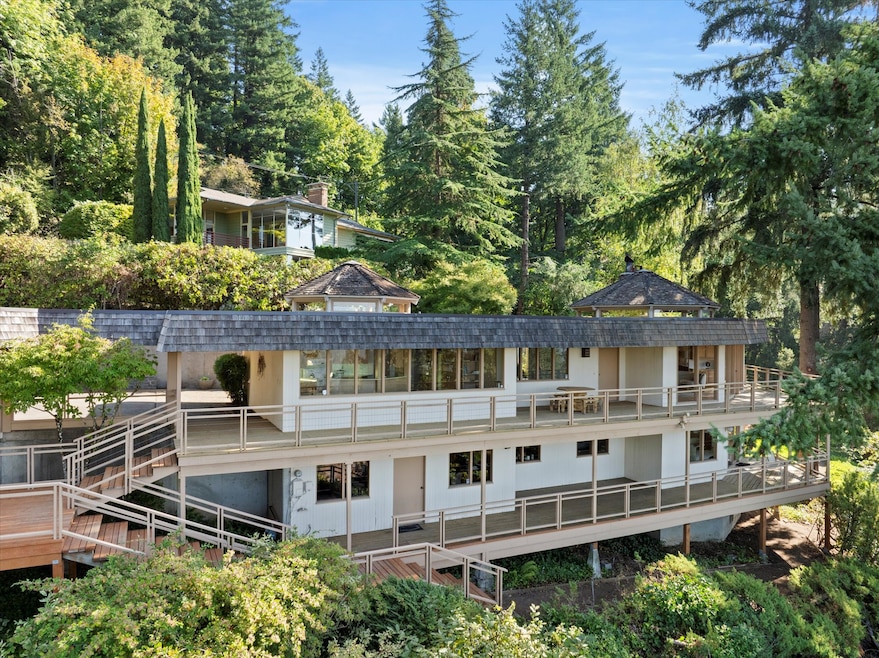
Oregon has a wealth of midcentury modern residences and they can trade quickly.
Tucked throughout the Pacific Northwest state, these 20th-century homes often attract serious offers within days of hitting the market, with design fans seeking the grounded layout and naturalistic backbone. But finding a midcentury modern home in the region designed by a female architect? That’s uncommon.
In Portland, it’s “very rare,” said Vetiver Street Real Estate broker Craig Weintz. “Portland has a strong midcentury history, but most of its architecture was designed by men.”
One exception: the property at 3332 SW Fairmount Lane that Weintz has listed for almost $1.3 million.
Dubbed “The Carousel House,” the 4,436-square-foot home was designed by Marjorie Wintermute, a Portland architect known for her standard-setting practice in a male-dominated profession. Success defined Wintermute’s early career — she drafted at Bonneville Power Authority and designed for Standard Oil before apprenticing with midcentury heavyweight Pietro Belluschi. She ended up leaving the gig after getting married in 1947.

The decision was “a thing which I would never have done today,” Wintermute said in a later interview. Although the choice was “what was expected in my time,” she said, she still considered it the “stupidest thing I ever did.”
A house in conversation with its landscape
Even so, Wintermute continued her practice, working independently over the next two or so decades. During that period, Wintermute completed The Carousel House for Portland’s Wyse family, which has owned the home since its completion.
That means the shingle-clad home is on the market for the first time in 50 years. The family hopes the house inspires “another generation the way it has inspired theirs,” Weintz said.
Completed in 1969, the two-story home hinges around a trio of octagons all threaded together to form a terraced, L-shaped structure wrapped in lofted decks. The interior flows from social to private space, with the original kitchen, dining and living rooms near the entrance, and the three bedrooms tucked toward the back or lower story. Clerestory windows run throughout, casting daylight into the wood-paneled rooms and framing slices of Portland’s sky.
It’s a design that still feels very alive, Weintz said. “How the light moves through the windows of the three octagonal spaces and how every detail feels intentional. It is not just a house; it is architecture in conversation with its landscape.”
That landscape also holds design history: Barbara Fealy, Oregon's first female fellow of the American Society of Landscape architects, schemed out the terraced plot, knitting it firmly into a wooded site that overlooks treetops in Portland’s Hillsdale neighborhood.
This Wintermute-Fealy collaboration “represents a meaningful and too often overlooked chapter of design history,” Weintz said.
In its roughly two weeks on the market, buyers “are drawn to the design, the natural light, the connection to the landscape and the story of two pioneering women behind it,” Weintz said.
Still, the agent noted, some interested homebuyers are balancing the potential costs associated with updating the home while honoring its architectural backbone. Another consideration: The home's adjoining lot is also for sale, priced at $400,000. The 0.19-acre parcel sits empty except for an original octagonal structure that Weintz noted could become a greenhouse or a studio.
Although the home’s West Hills market remains active, he noted, its buyers are “thoughtful and selective.”
“This home sits in a specific niche,” Weintz explained. “It appeals to buyers who value architecture and legacy as much as square footage or finishes. In this price range, homes with strong design identities can take longer to find the right buyer because it requires a match of vision and appreciation.”